Neutral Institutional Model
Based on C3N Neuropolycentric Architecture
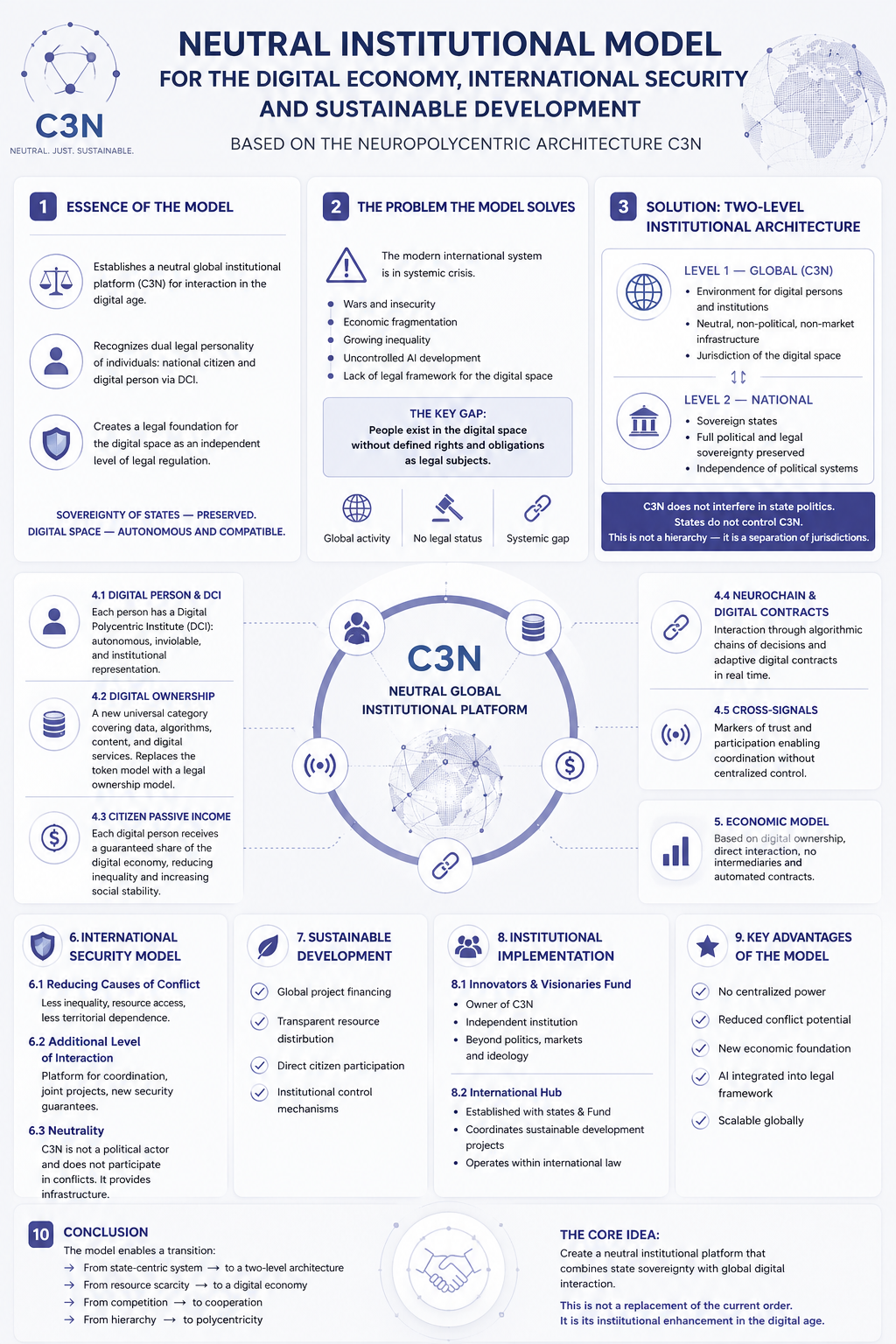
1. Essence of the Model
The Model proposes the creation of a new level of organization of international interaction in the digital era based on a neutral global institutional platform (CIP / C3N).
This platform is not:
- a supranational structure or strengthening of selected states;
- an alternative to existing international organizations;
- a classical financial or political system.
CIP forms an institutional digital infrastructure enabling interaction between states, economic agents, and citizens based on freedom, equality, and justice.
The Model recognizes that the digital environment already exists as a domain of economic, social, and technological interaction but lacks a unified legal nature.
It introduces:
- legal status for the digital space;
- rights and obligations of digital participants;
- mechanisms of ownership and responsibility in digital interaction.
Each individual operates simultaneously in:
- national jurisdiction (as a citizen);
- digital CIP space (as a digital subject via DPI).
This is not replacement of state law but its digital extension.
2. Problem Addressed by the Model
The modern international system is in structural crisis:
- wars and weakening collective security;
- global economic fragmentation;
- rising inequality;
- uncontrolled AI development;
- lack of institutional digital economy framework.
Currently:
- digital space lacks unified legal system;
- human rights are fragmented across jurisdictions;
- responsibility in digital environment is undefined;
- platforms, not institutions, regulate key processes.
This creates a mismatch: digital activity is global, but legal status remains local.
The system is state-centric, while reality is digital-global.
Thus: digital space exists de facto, but not de jure.
3. Two-Level Institutional Architecture
Global Level — CIP
- neutral digital infrastructure;
- non-political, non-market environment;
- space for interaction of digital institutions.
National Level
- sovereign states;
- full preservation of jurisdiction;
- no transfer of sovereignty.
This is separation of jurisdictions, not hierarchy.
4. Core Institutions
4.1 Digital Person (DPI)
Each individual receives a Digital Polycentric Institution (DPI) as:
- autonomous representation;
- management tool for rights and assets;
- institutional digital identity.
4.2 Digital Property
A new legal category: digital property as a universal economic institution.
- data;
- algorithms;
- content;
- digital services.
4.3 Civic Passive Income
Each participant receives a share of digital economy value creation:
- basic economic stability;
- reduced inequality;
- social stabilization.
4.4 Neurochain & Smart Contracts
- algorithmic decision chains;
- adaptive digital contracts;
- automated trust mechanisms.
4.5 Cross-Signals
Decentralized coordination and trust markers without central control.
5. Economic Model
Based on:
- digital ownership;
- direct peer interaction;
- elimination of intermediaries;
- automated contractual systems.
Effects:
- lower transaction costs;
- global scalability;
- transparent value distribution;
- inclusive economic participation.
6. International Security Model
Conflict Reduction
- economic inequality reduction;
- resource access via digital systems;
- reduced territorial dependency.
New Coordination Layer
- platform for state cooperation;
- joint project infrastructure;
- security guarantees mechanism.
Neutrality Principle
CIP is not a political actor and does not participate in conflicts. It functions purely as infrastructure.
7. Sustainable Development
- global project financing mechanisms;
- transparent resource allocation;
- direct citizen participation;
- institutional monitoring tools.
8. Institutional Implementation
Fund of Innovators and Visionaries
- owner of CIP;
- independent institutional structure;
- outside politics, markets, ideology.
International Hub
- coordinated with states;
- sustainable development execution layer;
- operates under international law.
9. Advantages
- no centralized authority;
- reduced systemic conflict;
- new digital economic foundation;
- AI integrated into legal framework;
- global scalability.
10. Conclusion
The Model defines a transition:
- from state-centric → to two-level system;
- from scarcity → to digital economy;
- from competition → to cooperation;
- from hierarchy → to polycentric architecture.
This is not replacement of existing order — it is its institutional extension into the digital era.