Dynamic Balance of Freedom, Equality, and Justice
(FADS / DIP)
FADS – Framework of Adaptive Digital Systems.
DIP - Digital Institutional Platform.
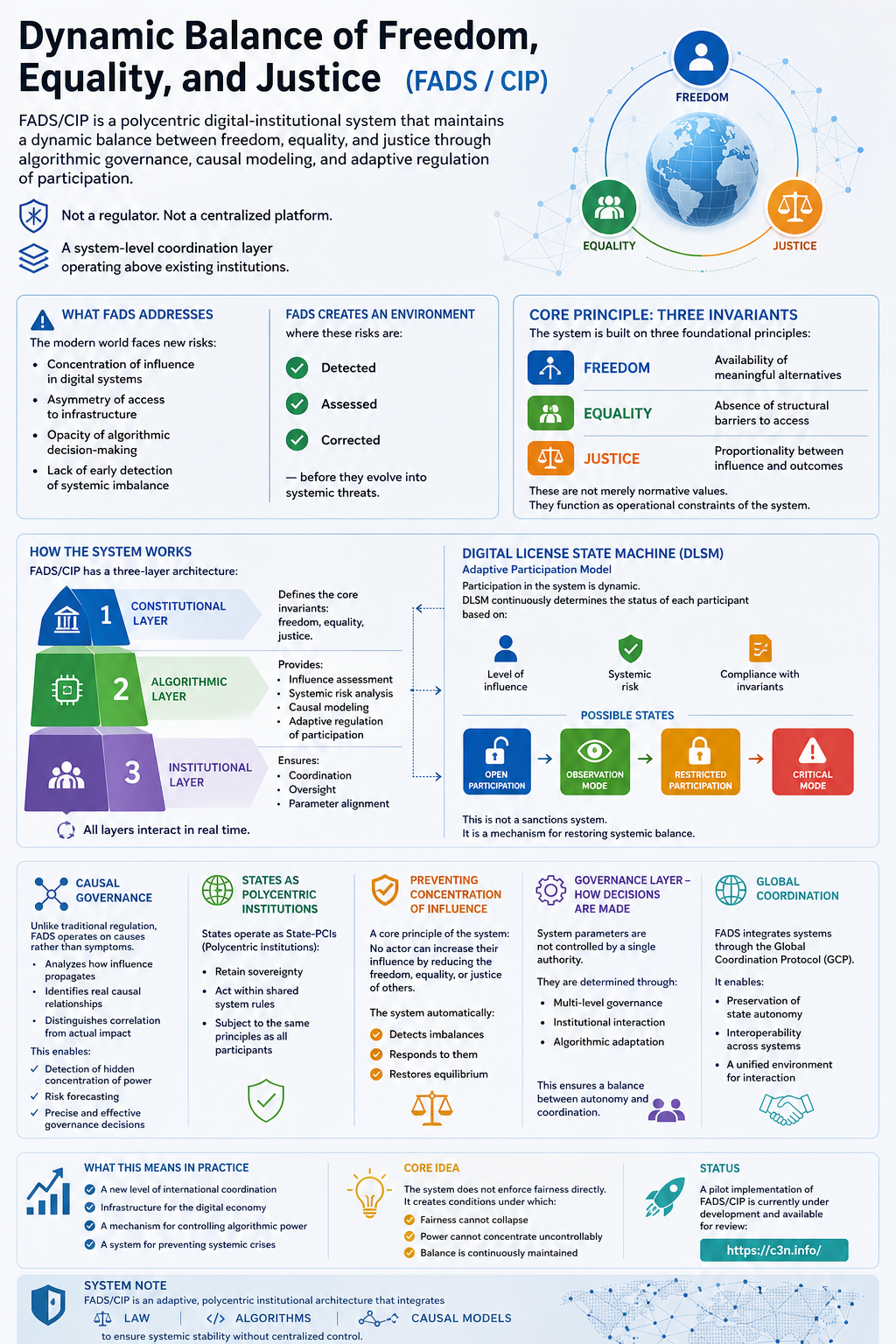
FADS/DIP is a polycentric digital-institutional system designed to maintain a dynamic balance between freedom, equality, and justice through algorithmic governance, causal modeling, and adaptive regulation of participation.
It is neither a regulator nor a centralized platform.
It is a system-level coordination layer operating above existing institutions.
What FADS Addresses
The modern world faces a new class of risks:
- concentration of influence in digital systems
- asymmetry of access to infrastructure
- opacity of algorithmic decision-making
- lack of early detection mechanisms for systemic imbalance
FADS creates an environment in which these risks are:
- ✔ detected
- ✔ assessed
- ✔ corrected
— before they evolve into systemic threats.
Core Principle: Three Invariants
- Freedom — availability of meaningful alternatives
- Equality — absence of structural barriers to access
- Justice — proportionality between influence and outcomes
These are not merely normative values.
They function as operational constraints of the system.
How the System Works
1. Constitutional Layer
Defines the core invariants: freedom, equality, justice.
2. Algorithmic Layer
- influence assessment
- systemic risk analysis
- causal modeling
- adaptive regulation of participation
3. Institutional Layer
- coordination
- oversight
- parameter alignment
All layers interact in real time.
Digital License State Machine (DLSM)
Adaptive Participation Model
Participation in the system is dynamic.
DLSM continuously determines the status of each participant based on:
- level of influence
- systemic risk
- compliance with system invariants
Possible states:
- open participation
- observation mode
- restricted participation
- critical mode
This is not a sanctions system.
It is a mechanism for restoring systemic balance.
Causal Governance
Unlike traditional regulation, FADS operates on causes rather than symptoms.
- analyzes how influence propagates
- identifies real causal relationships
- distinguishes correlation from actual impact
This enables:
- ✔ detection of hidden concentration of power
- ✔ risk forecasting
- ✔ precise governance decisions
States as Polycentric Institutions
States operate as State-PCIs:
- retain sovereignty
- act within shared rules
- follow the same principles as all participants
This reduces the risk of systemic capture.
Preventing Concentration of Influence
No actor can increase their influence by reducing the freedom, equality, or justice of others.
- detects imbalances
- responds to them
- restores equilibrium
Governance Layer
- multi-level governance
- institutional interaction
- algorithmic adaptation
Ensures balance between autonomy and coordination.
Global Coordination
Global Coordination Protocol (GCP) enables:
- preservation of state autonomy
- interoperability
- unified interaction environment
What This Means in Practice
- a new level of international coordination
- infrastructure for the digital economy
- control of algorithmic power
- prevention of systemic crises
Core Idea
The system does not enforce fairness directly.
- fairness cannot collapse
- power cannot concentrate uncontrollably
- balance is continuously maintained
Status
A pilot implementation is under development:
👉 https://c3n.info/